Saturday, February 03, 2007

SQL Server Full Text Search Optimization

SQL Server Full Text Search Optimization


Full text indexing is a great feature
that solves a long running database problem, the searching of textual data columns for specific words and
phrases in SQL Server databases.

However, as the full-text search engine is a
separate component of SQL Server (it uses the Microsoft Search Service) this
can be a potential performance problem due to the way full-text search interacts
with SQL Server.


Full-text search works really well when you are
searching a text column and you are interested in all the rows that match your
highly selective search criteria. However, full-text search is commonly used
with other SQL Server predicates, such as those included in the WHERE clause.


powered by performancing firefox

Understanding SQL Server Full-Text Indexing

Understanding SQL Server Full-Text Indexing in MSSQL Server 2000 and MSSQL Server 2005

Microsoft SQL Server supports T-SQL, an implementation of ANSI standard SQL. T-SQL is designed to (among other things) search for matches in your data. For example, if you've created a table with a column named Notes you could construct these queries:


SELECT * FROM MyTable WHERE Notes = 'Deliver Tuesday'

SELECT * FROM MyTable WHERE Notes LIKE '%caution%'

But what if you're not looking for an exact match, either to the full text of the column or a part of the column? That's when you need to go beyond the standard SQL predicates and use SQL Server's full-text search capabilities. With full-text searching, you can perform many other types of search:

  • Two words near each other
  • Any word derived from a particular root (for example run, ran, or running)
  • Multiple words with distinct weightings
  • A word or phrase close to the search word or phrase
detail...


powered by performancing firefox

The control with ID 'UpdatePanel1' requires a ScriptManager on the page. The ScriptManager must appear before any controls that need it

When I first migrate the DataView form the original place to UpdatePanel, recompile it and error message returned:

"The control with ID 'UpdatePanel1' requires a ScriptManager on the page. The ScriptManager must appear before any controls that need it"


Solution:

http://forums.asp.net/thread/1527394.aspx


You need to add the ScriptManager to your page. The ScriptManager control manages script resources for Microsoft ASP.NET AJAX pages


id="form1" runat="server" /> ID="ScriptManager1" runat="server" / />


powered by performancing firefox

Wednesday, January 31, 2007

Meeting with supervisor

After meeting with supervisor, Dr Yuen, Geoffrey and Wah shows their view points on my project system.

Firstly, Wah ask what if the URL share among the users are identical. For example, if User A save hk.yahoo.com as a Portal site and User B save hk.yahoo.com as a search engine, the URL will be duplicated in the database. Well, this is not a problem becuase, say in the YouTube system, when we search "Frilled Shark", more than 4 same vedio chips will be returned and, it indicated that the searching result is accurate. Dr Yuen suggested that one of the development approach in my stage is that, I can enhance the accuracy on the searching data among the various items in the system.

Afterward, Dr Yuen asked the selling point of my project, well I can hardly tell the different, I response by saying "Well, by comparing the one man work, I do better than them as a team :p" Seriously, the furture mile stoneof my project probably support the different character, espeacially the Asian fonts because, for example, the FURL.net have problem on saving the Traditional Chinese character, I think I will/need to trigger this problem.

Dr Yuen also suggested me to integrate the two algorithms into one and implementation this 'new' algorithm on doing associate analysis. These two algorithm, Apriori Algorithm and FP-Tree, have different approach.
Apriori Algorithm is base on counting the itemsets' frequency. If the frequent of itemset is low, elimnate that item(s) and the remaining enter the next stage. Finally, the resulting item(s) is/are the most likely be related among the other tags.
FP-Tree,on the other hand, is based on classifying the frequency of the tags used into the hush table. The most frequent tags will get the higher position in the hush table and lower frequent items list under them. Under this method, the completeness of the association pattern maintains, and the computational power required is lower than Apriori method.

Lastly, Dr Yuen suggested that the system should utliminately make LESS involvement, like 1. totally no input of tags by user and 2. eliminate the unneccessary user interaction on the site but the newly added data can embed to the system automatically. I think the first one can be achieved by combining the AJAX and Association Pattern suggestion like the one did by Del.icio.us. I think this function will be implement in Phase 3

Progress log in Janurary

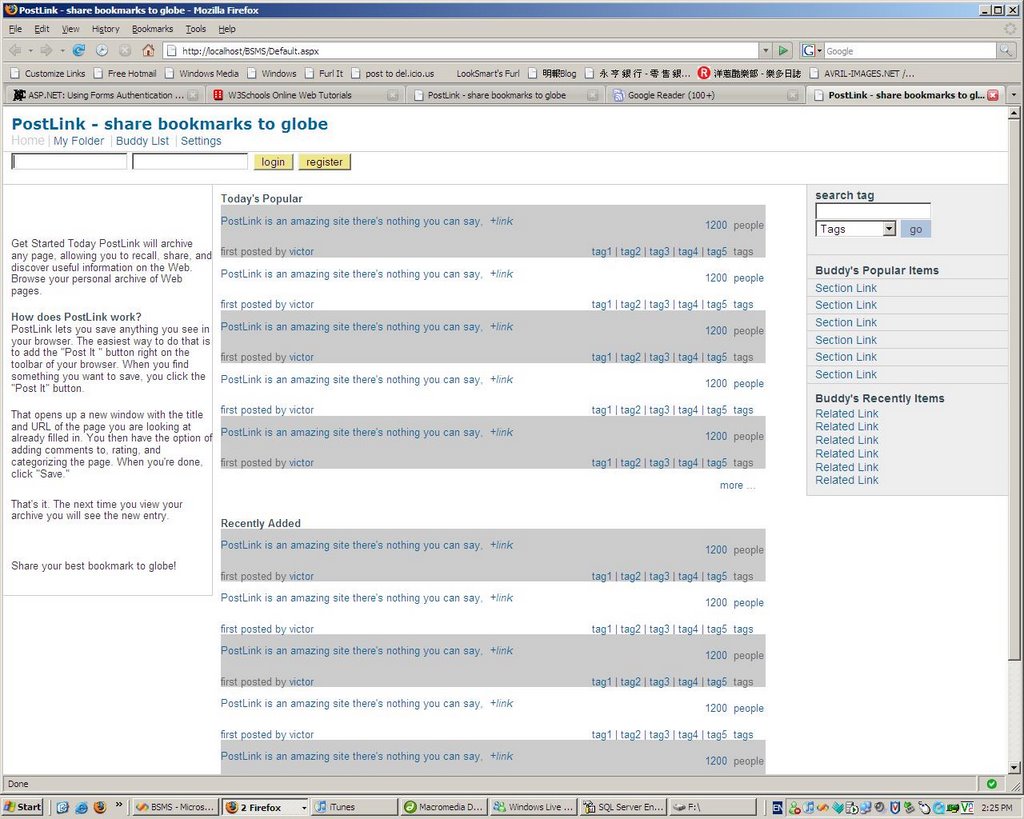
The project has entered the major mile stone and the link suggestion and searching engine using in the site are building. In Jan., beside finish writing the User Interface of the site like user registration, buddy list update, adding the new link and adding new link throw the Bookmarklet have been finished.
In Feb., I will focus on developing the Association Analysis which is used for frequent pattern mining. After finishing this functional implementation, the project will be almost done and enter the testing phases.

The Alpha version of my project can be accessed through this link:
http://144.214.121.62/BSMS/Default.aspx

The latest changes and update of my progress can be checked via the follow link:
http://cslabvictor.blogspot.com/

Saturday, January 27, 2007

Bookmarket tool

http://www.bookmarklets.com/tools/categor.html

Work on the bookmark system like remove the JavaScript in the viewing pages, send the searching value into the search engine etc.


powered by performancing firefox

Friday, January 26, 2007

ASP.NETWeb: The Official Microsoft ASP.NET 2.0 Site: Videox

http://www.asp.net/learn/videos/default.aspx?tabid=63#ajax

Videos for ASP.NET 2.0 beginner and AJAX developer


http://blogs.msdn.com/mattgi/archive/2007/01/23/asp-net-ajax-validators.aspx

Known issue after installing the AJAX v1.0 extension for ASP.NET 2.0

ASP.NET AJAX Validators

ASP.NET
AJAX provides new APIs for registering script with the ScriptManager.
Using these APIs allows controls to work well with partial rendering.
Without them, controls placed inside an UpdatePanel won't work as
expected. In previous CTP releases of ASP.NET AJAX, we had a set of
validator controls that derived from the v2.0 controls and used the new
APIs. This made them work well with ASP.NET AJAX. WindowsUpdate will
soon include a version of System.Web that can take advantage of the new
APIs. So the new controls which would have been redundant have been
removed. However, the update isn't available yet and ASP.NET AJAX has
been released. So, in the short-term, the source code for a set of
custom validator controls that work with partial rendering is available
here.


powered by performancing firefox

Sunday, January 21, 2007

Web mining for web personalization

Web mining for web personalization
Magdlini Eirinaki and Michalis Vazirgiannis
Athens University of Economics and Business

ACM Transaction on Internet Technology, Vol. 3., No 1, Feb., 2003, Page 1 - 27

Introduction

Web personalization is defined as any action that adapts the information or services provided by a Web site to the needs of a particular user or a set of users, taking advantage of the knowledge gained from the user’s navigational behavior and individual interests, in combination with the content and the structure of the web site.

Objective:

The objective of a web personalization system is to provide users with the information they want or need, without expecting from them to ask for it explicitly.

The content management is the process classifying the content of a web site in semantic categories in order to make information retrieval and presentation easier for the users. Content management is very important for web sites whose content is increasing on a daily basis, such as news sites or portals.

Web personalization

… the analysis of the collected data, and the determination of the actions that should be performed. The ways that are employed in order to analyze the collected data include content-based filtering, collaborative filtering, rule-based filtering and Web usage mining.

Content-based filtering systems: are solely based on individual users’ preferences. The system tracks each user’s behavior and recommends items to them that are similar to items the user liked in the past.

Collaborative filtering systems invite users to rate objects or divulge their preferences and interests to them. This is based on the assumption that users with similar behavior have analogous interests.

The data mining methods that are employed are: association rule mining, sequential pattern discovery, clustering and classification. This knowledge is then used from the system in order to personalize the site according to each user’s behavior and profile.

User profiling

In order to personalize a web site the system should be able to distinguish between different users or groups of users. This process is called user profiling and its objective is the creation of an information base that contain the preferences, characteristics, and activities of the users.

Log analysis and web usage mining:

By applying statistical and data mining methods to the web log data, interesting patterns concerning the user’s navigational behavior can be identified, such as users and page clustering, as well as possible correlations between web pages and user groups.

The web usage mining process can be regards as a three-phase process, consisting of the data presentation, pattern discovery, and pattern analysis phases. In the first phase, log data are preprocessed in order to identify users’ session, page views and so on. In the second phases, statistical methods, as well as data mining methods (such as association rules, sequential pattern discovery, clustering and classification are applied in order to detect interesting patterns.

Most important of all is the user identification issue. More accurate approaches for a priori identification of unique visitors are the use of cookies or similar mechanisms of the requirement for be the reluctance of users to share personal information.

Web usage mining

More advanced data mining methods and algorithms tailored appropriately are use in the Web domain include association rules, sequential pattern discovery, clustering and classification. Association rule mining is used in order to reveal correlations between pages accessed together during a server session. It can reveal association between groups of users with specific interests.

Sequential pattern discovery is an extension of association rules mining in that it reveals pattern of concurrence incorporating the notion of time sequence. Clustering is used to group together items that have similar characteristics. In the context of web mining, we can distinguish two cases, user clusters and page clusters.

Page clustering identifies group of pages that seem to be conceptually related according to the user’s perception. User clustering results in group of users that seems to behave similarly when navigating through a Web site.

Classification is a process that maps a data item into one of several predetermined classes. In web domain classes usually represent different user profiles and classification is performed using selected features that describe each user’s category. The most common classification algorithm are decision trees, Naïve Bayesian classifier, neural networks, and so on.

After discovering patterns from usage data, a further analysis has to be conducted. The exact methodology that should be followed depends on the technique previously used. The most common ways of analyzing such patterns are either by using a query mechanism on a database where the results are stored, or by loading the results into a data cube and then performing OLAP operations. Additionally, visualization technique are used fir an easier interpretation of formation convening the web site there can be extracted useful knowledge for modifying the site according to the correlation between user and content groups.

Research initiatives

Most of the efforts focus on extracting useful patterns and rules using data mining techniques in order to understand the users’ navigational behavior, so that decision concerning site restructuring or modification can then be made by humans. In several cases, a recommendation engine helps the user navigates through a site.

A different approaches is adopted by Zaiane et al. the authors combine the OLAP and data mining techniques and a multidimensional data cube, to extract interactively implicit knowledge. Their webLogMiner system after filtering the data contained in the web log, transforms them into a relational database. In the next phase a data cube is built, each dimension representing a field with all possible values described by attributes. OLAP technology s then used in combination with data mining techniques for prediction, classification and time-series analysis of web log data.

Pattern discovery is accomplished through the use of general statistics algorithms and data mining techniques such as association rules, sequential pattern analysis, clustering and classification. the result then analyzed through a simple knowledge query mechanism, a visualization tool, or the information filter, that makes use of the preprocessed content, and structure information to automatically filter the results of the knowledge discovery algorithms.

Saturday, January 13, 2007

Function that like StringTokenizer in C#

Function that like StringTokenizer in C#

Question: 我有一个字符串,我想以空格把里面的单词分开,以前在Java中有StringTokenizer很方便,不知C#中有没有类似的.

using System;

using System.Text.RegularExpressions;


class SplitTest

{

public static void Main()

{

String s = "Hello, Houston,I,am,coming";

Console.WriteLine("First example:");

Console.WriteLine("Original stirng:" + s);

Console.WriteLine("After splitting:");


String[] tokens = Regex.Split(s,",");

for (int i=0; i tokens.Length; i++)

Console.WriteLine(tokens[i]);


s = "Hello | Houston | I | am | coming";


Console.WriteLine("Second example:");

Console.WriteLine("Original stirng:" + s);

Console.WriteLine("After splitting:");


tokens = Regex.Split(s,@"\s*\|\s*");

for (int i=0; i tokens.Length; i++)

Console.WriteLine(tokens[i]);

}


}


powered by performancing firefox

Thursday, January 11, 2007

get RETURN VALUE from SYBASE stored procedure [Also apply to MSSQL2000]

http://forums.asp.net/thread/1333707.aspx

I can handle the returned value base on the storedProcedure conduct in MSSQL2000 with the following code:
ASP.NET
try
{
storedProcCommand.CommandType = CommandType.StoredProcedure;
storedProcCommand.Parameters.Add("@userid", Session["UserName"].ToString());
storedProcCommand.Parameters.Add("@buddyid", tbNewBuddy.Text);
cn.Open();

if (Convert.ToString(storedProcCommand.ExecuteScalar()) == "Success")
{
lbDisplay.Text = "New buddy added. / />
}
else
{
lbDisplay.Text = "Sorry, there is no such buddy. / />
}
}// end try
catch (Exception ex)
{
lbDisplay.Text = ex.ToString() + @" / />
}
finally
{
cn.Close();
}

Stored Procedure in SQL2000
CREATE PROCEDURE userBuddyAdd
@userid nvarchar(50),
@buddyid nvarchar(50)

With Recompile
AS
Declare
@intCheckBuddyExist int,
@intCheckAdd int,
@intSameUserId int
-- Check if buddy exist in the userinfo
Select @intCheckBuddyExist = count(*) from userinfo where userid = @buddyid

-- Check if the buddy id is user id
Select @intSameUserId = count(*) from userbuddy where userid = @userid and userid = @buddyid

-- Check if buddy already added
Select @intCheckAdd = count(*) from userbuddy where userid = @userid and buddyid = @buddyid

-- Add Buddy only if not been added
if @intCheckBuddyExist = 1 and @intCheckAdd = 0 and @intSameUserId = 0
begin
INSERT INTO userbuddy VALUES(@userid,@buddyid)
if @@Error = 0 Goto SUCCESS
end

-- Return addition fail if the buddy does not exist in the list
if @intCheckBuddyExist = 0
Goto PROBLEM
Return 0

PROBLEM:
Select 'Fail'
Return 1

SUCCESS:
Select 'Success'
Return 2

GO

Monday, January 08, 2007

http://support.microsoft.com/default.aspx/kb/925336

Error message when you try to install a large Windows Installer package or a large Windows Installer patch package in Windows Server 2003 or in Windows XP: "Error 1718. File was rejected by digital signature policy"

View products that this article applies to.
Article ID : 925336
Last Review : October 3, 2006
Revision : 1.1
SYMPTOMS
When you try to install a large Microsoft Windows Installer (.msi) package or a large Microsoft Windows Installer patch (.msp) package on a computer that is running Microsoft Windows Server 2003 or Microsoft Windows XP, you receive the following error message:
Error 1718. File FileName was rejected by digital signature policy.
Back to the top Back to the top
CAUSE
This problem occurs when the computer has insufficient contiguous memory for Windows Server 2003 or Windows XP to verify that the .msi package or the .msp package is correctly signed.
Back to the top Back to the top
WORKAROUND
To work around this problem, follow these steps:
1. Click Start, click Run, type control admintools, and then click OK.
2. Double-click Local Security Policy.
3. Click Software Restriction Policies.

Note If no software restrictions are listed, right-click Software Restriction Policies, and then click Create New Policy.
4. Under Object Type, double-click Enforcement.
5. Click All users except local administrators, and then click OK.
6. Restart the computer.
Important After you follow the previous steps, local administrators can install the .msi package or the .msp package. After the package is installed, reset the enforcement level by following the previous steps. In step 5, click All users instead of All users except local administrators.

Seessment result on Interim report

You got B grade for your interim report. Here is the comment from your supervisor:


------------------------------


The
related work section is good and the report is well-organized.
there are some minor mistakes on the formatting and the
writting, the student has done a reasonbly good work


powered by performancing firefox

Friday, January 05, 2007

Finished building of user registeration, add new item and modify user settings


In the past 10 days, the user registeration has been finished and tested. On the other hand, user can add other buddy that has been registered. User now can add itme under their account and they can add other buddy by inputting their userid. Once buddy inserted a new item, user can view that itme under the buddy's latest update page.

User now can change their setting like setting the default topic as the last-used, search the information based on the tags, or keyword or use both of them.

The next major implementation will be building the searching function which I think is the most difficult part of the project. I wish I can finish the basic function, namely phase one of the searching function like return the related item base on the tag that user input in the search field first. After then, it will be improved by adding function like searching the alike information based on user's preferences and user's tags trendency, better result should be return in phase two.
In my progress, I expect phase one can be finished by 15th January, 2007

Friday, December 22, 2006

Login and Logout finished


Login and Logout functions finished.
I am working on the registeration and the item inserting; both working by the stored-procedures in the SQL server. Expected Finished date: 25th December, 2006 Mid-night.

Thursday, December 21, 2006

ASP.NET: Using Forms Authentication in ASP.NET

ASP.NET: Using Forms Authentication in ASP.NET

References:

User Interface is finished

The User Interface has been update and finished.
Since this is the migration of functions from the old UI to this new UI, I am conducting the implementing of the basic functions like login, logut, insert new itmes like URL, tags, topic selection and comments etc. I planned the implmentation will be finished within 5 day.

Saturday, December 16, 2006

Resume the development work

I have already restarted my work from 16th Dec., 2006. 1 day after my final examination this semester.

Thursday, November 30, 2006

Web 2.0 from Dr Andy Chun

Web 2.0 from Dr Andy Chun
http://www.zdnetasia.com/blog/web2/

Saturday, November 11, 2006

Suggestion on making tag on classification

Although there are no standard guidelines on good tag selection practices, those in the folksonomy community have offered many ideas. Some “best practices” including:

  1. using plurals rather than singulars
  2. using lower case.
  3. grouping words using an underscore,
  4. following tag convention started by others and
  5. adding synonyms.

Many folksonomies allow users to modify this tags, and there is considerable scope for users to tidy up the entries that they have already created. Currently, tags are generally defined as single words or compound words, which means that information can be lost during that tagging process. Single-word tags lose that information that would generally be encoded in the word order of a phrase.

The commonness of compound tags, including tags that concatenate more than two words, may suggest that users miss the richness of the sentence structure. The “non-breakable space” can be introduces. Although many compound words are produced sing separator characters, such as this_is_tag.

Several del.icio.us taggers have established a private presudo-hierarchy of terms, by establishing tag conventions that resemble directory tructures, such as, Programming/C++, Programming/JAVA.

Smart systems

Alongside education users, there is much that system creators can do to improve the end-data their systems are helping to create. There are tow main ways in which improvements can be made. Firstly, much can be done at the point at which new resources are contributed to the system. Error-checking potentially accounts for a number of tag errors --- although rather fewer misspellings occur than may be expected. Furthermore, some sites already make tag suggestions when users submit resources. Scrumptions, a recent Firefox extension, offers popular tags for every URL. Systems could easily suggest synonyms, expansion of acronyms, and the like when users type in their tags.

Secondly, improvements can be made in the way systems search for resources already in the system. Synonyms suggestions could also be made here, suggesting for example, “ladybug” instead of “ladybird”.

Clay Shirky notes:

“Tagging gets better with scale. With a multiplicity of points of view the question isn’t ‘’ Is everyone tagging any given line ‘correctly’’’, but rather ‘’ Is anyone tagging it the way I do?’’ As long as at least on other person tags something the way you would, you’ll find it – using a thesaurus to force everyone’s tags into tighter synchrony would actually worsen the noise you’ll get with your signal. If there is no shelf, then even imagining that there is one right way to organize things is an error.”

Conclusions

The investigations described in the article are brief, simple and relatively unscientific, as are the number provided within. That the results from both del.icio.us and flickr tended to be rather similar imply that they can be trusted only as much as a short, seat-of-the-pants. Only those with direct access to the del.icio.us nd flickr databases can be aware of the exact state of affairs and how it has changed across the months. For the research purposes, the interesting features of the tags are not in the precise percentages of usage, but in the choice of tag, the choice of structure, and the choice of language. Somewhere around a third of tags were indeed “malformed”, in tat they were beyond the grasp of a multilingual spell-checker for on e reason or another. Many of there were not misspelt, but mis-constructed, some of the latter in a correctable manner.

Still, possibly the real problem with folksonomies in not their chaotic tags but they are trying to serve two masters at once; the personal collection and the collective collection. So it possible to have the best of both worlds? At the moment, many investigations of tag data are in progress, including how tags can be used for searching. As a consequence, development in this fields tends to confine itself to methods for improving the quality of the user-contributed tags for this purpose. In practice, this involves promoting commonly-chosen tags above single-use or infrequently used tags by various means. It is possible that the data collected through folksonomy tagging is more complete than we had imagined. Some single-use tags are explicitly designed as such, such as the latitude/longitude makers used by geotagging. Some may be perceived as valuable or helpful to the reader. Some may be infinitely helpful for search purpose, if only the information provided therein is accessed in an appropriate manner. Is it therefore preferable, rather than attempting to stamp out single use or sloppy tags, to suggest that each item be tagged with mixture of approaches, including several search-friendly keywords?


Source: http://webdoc.sub.gwdg.de/edoc/aw/d-lib/dlib/january06/guy/01guy.html

Folksonomies
Tidying up Tags?

Marieke Guy
UKOLN


Emma Tonkin
UKOLN

from D-Lib Megazine

Draft:The Data Mining of Collaborative Bookmark-sharing System

The Data Mining of Collaborative Bookmark-sharing System

Introduction

Recent year there are online bookmark system on the Internet. User, namely authors, can share their web page bookmark from the centralized portal like Del.icio.us and these webs are categorized by tagging, which means adding keywords to Internet resources without relying on a controlled vocabulary. Therefore information can be indexed and users can access the categorized web page easily base on tags. This process is called the Collaborative Tagging which “describes the process by which many users add metadata in the form of keywords to shared content” (Golder S.A. and Huberman B.A, 2005).

Related Work

Some data mining technique involved in the Collaborative Tagging technology like searching different kinds of web page in the databases, interactive mining based on the user’s preferences, incorporation of background knowledge that integrate the background knowledge in the categorized information in order to find the interestingness of data. “Data mining system can uncover thousands of [interesting] patterns.” (Han J. and Kamber M., 2001). Since the content in the Internet is huge and still growing, it is difficult to conduct the traditional text document control by the traditional data mining method. In addition, the web is “highly dynamic information source … its information is also constantly updated” (Han J. and Kamber M., 2001). Take search engine as an example, data is categorized by the authorized party like the authors or database administrator cannot categorize all the web page from time to time in order to cope with the rapid growing of the web data. Han and Kamber point out that topic of any breadth may contain hundreds of thousand of documents and this can lead to huge number of document entries returned and only small part of documents are relevant. On the other hand, many documents that are high relevant to a topic usually does not contain keywords to defining them. Collaborative Tagging can solve some of the problems since the useful data is categorized by both authors and users in the community. Only useful data are filtered and returned from the system base on the searching relevant tags. Other users can use these categorized and “cleaned” data for searching based on the tags. Sadly, only common tags can return the most relevant web data and usually tag only serve for personal purpose and common tags is hardly implemented.

Tagging can eliminate the word inflections if there is a lemmatization engine, which determines the lemma for a given word, could trigger in the input stage. “Folksonomies (Collaborative Tagging) are characterized by flaws that formal classification systems are designed to eliminate including polysemy and synonyms.“(Wikipedia, 2006). Many data collecting system use tagging to classify the data because people believe that user involvement on the categorization is more accurate and human-readable than the artificial classifier base on the statistics. “Tagging system has the potential to improve search, spam detection, reputation systems and personal organization while introducing new modalities of social communication and opportunities for data mining.”(Marlow C., Naaman M., Boyd D. and Davis M., 2006). However, if certain degree of regulation used in the traditional data mining technique involves in filtering the tagged data can produce more accurate results than simply return all “unclear” tagged information that made by the authors. One of the data mining technique is data cleansing process which can remove the “low-quality, redundant or nonsense metadata, and the potential risks of tidying too nearly and thereby losing very openness that has made folksonomies so popular” (Guy M., Tonkin E., 2006). This project is trying to combine freedom on choosing right tag to categorize the web data and retrieve the useful information by using the data cleansing method in order to create some degree of relationships between the content provider (authors) and the users. Although the tagging system cannot replace for formal system like the search engine but this project can improve the accuracy and relevancy of the returned information and “[treat] this as ring the core quality that makes folksonomy tagging so useful.” (Guy M., Tonkin E., 2006).


References:

Cameron M, M. Naaman, D. Boyd and M. Davis. (2006). HT06, tagging paper, taxonomy, Flickr, academic article, to read. Proceedings of the seventeenth conference on Hypertext and hypermedia. 31-40.

Folksonomy – Wikipedia. [Online]. Wikipedia. Available: http://en.wikipedia.org/Folksonomy [2006, Nov. 8]

Guy M. and T. Emma. (2006, January). Folksonomies: Tidying up Tags?[Online]. D-Lib Magazine 12. Available: http://www.dlib.org/dlib/january06/guy/01guy.html

Jiawei. H., and M. Kamber. (2001) Data Mining: Concepts and Techniques. San Diego, C.A.: Academic Press.

Scott A.G. and B.A. Huberman. (2006). Usage Patterns of Collaborative Tagging Systems. Journal of Information Science,32(2). 198-208